It is difficult to demonstrate any kind of online interest in the subject of running without being bombarded with opinion, recommendations and hard sell with regard to how best to reap the benefits of training and to maximise performance.
There is so much opinion, dressed up in glossy internet or social media finery, that for many it must be nigh on impossible to discern fact from hype or to tell a genuine expert from a snake-oil salesman. There are certainly plenty of the latter. There are also a large number of people out there who do have some valid experience and some relevant knowledge, but who are still operating out with the scope of their level of expertise.
The problem is that if a particular opinion takes hold, or worse still, is then backed by a host of self-proclaimed experts and self-publicists, such opinion can easily transform overnight from speculation, niche thinking or insubstantial theory to widely accepted truth.
I like to think that I am perhaps less gullible than some. I am certainly more cynical and sceptical than most, so I need a fair bit of persuading about most things. Furthermore, I have stated elsewhere previously that I am instantly suspicious of any idea or proposition that has the support of the majority. This seems ever more important in a world which is increasingly affected by fake news, unreliable imagery, online charlatans and the worst of all species, influencers.
The world of running is no exception. In fact, like much of the wider world of sport, there are so few true experts with a genuine and relevant scientific pedigree that it is no wonder that there are so many other self-promoted ‘experts’ filling the void. That is even before we start on AI which will soon make the majority of human sports coaches redundant anyway.
How many people bought into the whole 10,000 steps fad? For that matter, how many still do? Now, I fully concede that doing 10,000 steps a day is infinitely more beneficial than doing bugger all but there is no science whatsoever behind it. It began as a marketing gimmick in 1960s Japan.
For a short while though, I did consider that there might be some credibility to what appeared to be widely accepted opinion as to the optimal benefits of Zone 2 training.
For a number of years now, popular sports media has positioned Zone 2 training as the optimal intensity for improving mitochondria and fatty acid oxidisation, improving cardiometabolic health and in general for best building an aerobic base. In other words, if you want to maximise sustainable weight loss, improve overall health and build a strong level of aerobic fitness and stamina, Zone 2 is where you want to be.
Many proponents of this position have taken it further to suggest that the optimal fitness benefits accrued from Zone 2 training might in fact be negated by straying into higher intensity training zones. Clearly, this was a bit of a sea change, particularly amongst those fitness afficionados who believed that you had to train to a near-death state on every occasion in order to secure meaningful improvement and maximise performance.
What are the training Zones?
Before going any further, I should provide a little explanation of training zones and their perceived relevance. Some readers may not be totally familiar with the concept.
Training or exercise zones are based on heartrate. They have nothing whatsoever to do with distance, time or type of activity. Age however is a factor as I will explain.
It is most widely accepted that there are five training zones, numbered one to five. Shocker! The table below best explains the different zones, the heartrate range that they represent as well as a broad description of the level of relevant training intensity.
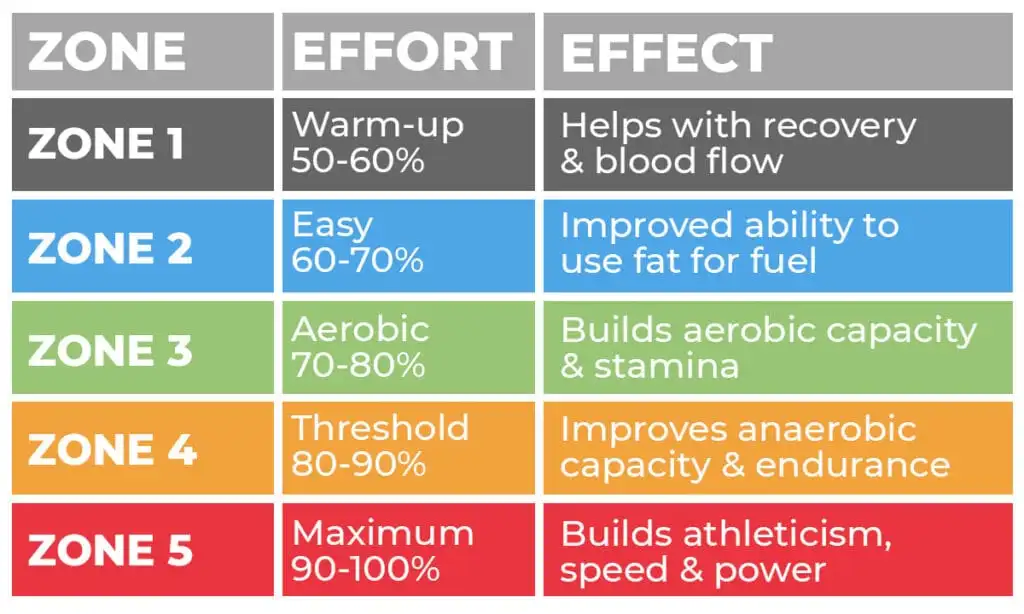
You can of course personalise the five zones with some simple mathematics. I have the maths ability of an amoeba so if I can grasp it, pretty much anyone can.
The following is one of the most commonly used formulas to calculate your training zones.
First you calculate your maximum heart rate (100%) by subtracting your age from 220. Other suggest subtracting your resting heart rate from your maximum heart rate as a starting point but we’ll stick to age for now. I’ll use myself as an example.
220 minus 58 = maximum heart rate of 162 beats per minute (bpm)
To work out what my Zone 2 is, I then calculate the upper and lower percentages of maximum heart rate, as follows.
For 60% of maximum heart rate – 162 x 0.6 = 97
For 70% of maximum heart rate – 162 x 0.7 = 113
Thus, my Zone 2 range is exercise resulting in a heartrate between 97 and 113 bpm. Calculating the other zones simply involves changing the percentage figure (i.e 0.5 to 0.9 as applicable).
As it will become relevant later, here are my Zones as per the method outlined above.
Zone 1 – 81 to 97 bpm
Zone 2 – 97 to 113 bpm
Zone 3 – 113 to 129 bpm
Zone 4 – 129 to 145 bpm
Zone 5 – 145 – 162 bpm
My first observation is that this method might provide a ballpark number for those with a more sedentary lifestyle/history, but I doubt that it takes into account an established level of base aerobic fitness, especially in older age groups. I will happily state that I do not for a minute accept that my maximum heart rate is as low as 162.
In fact, this method of calculation is largely frowned upon as being too inaccurate. However, there are other methods of calculation which are purported to provide a more reliable figure for those who are older, but who maintain a good level of fitness.
Here are my calculations using the Nes et al. (Nickleini method) 2011, which is regarded as one of the more reliable mathematical formulae.
Maximum heart rate is calculated by subtracting 0.64 x age from 211.
211 – (0.64 x 58) = 174
Instantly, this number seems far more in keeping with what I know experientially from my running and heartrate data. I know that I start to feel somewhat uncomfortable if I exceed 175bpm for any duration.
How then does this affect the five zones?
Using the same calculations as the previous method but using 174 as the max, my zones would look more like this.
Zone 1 – 87 to 104 bpm
Zone 2 – 104 to 122 bpm
Zone 3 – 122 to 139 bpm
Zone 4 – 139 to 156 bpm
Zone 5 – 156 to 174 bpm
In terms of my own experience and the data produced by my Garmin, these appear to be a far more accurate representation than the numbers produced by the more rudimentary age-subtraction method.
In words rather than numbers then , Zone 2 is roughly described as ‘easy’ or low intensity exercise below the lactate threshold. In more colloquial terms, exercise during which you could hold a conversation but not sing. A blessing in a great many cases.
The most basic practical description of Zone 2 exercise would be a brisk walk with a purpose as opposed to a casual stroll.

What does this mean for running?
Every runner is different and as we have already discussed, age is also a factor. There will be many very capable or elite runners out there with very slow standing heart rates who may be able to run efficiently in Zone 2, albeit at a fraction of their tempo or fastest race pace.
I would like to suggest though that a large proportion of runners might struggle to run, even slowly, and remain in Zone 2. I’ll come back to that soon with my own perspective.
Thus, if the theory that has prevailed for quite some time holds true, most runners can only comply by breaking into a very slow run at best. Yet, this is purported to be the optimum training zone for building a strong aerobic base and the pace at which the majority of training should take place.
I ask you then, how many of you runners out there have successfully built a strong and progressive training platform based almost exclusively on Zone 2 training, if indeed one is even able to confine one’s training to Zone 2 work?
It is a rhetorical question of course, but I suspect the actual percentage to be quite low, especially if everyone is honest.
If you trawl a lot of the internet forums, there are lots of tales of running epiphany from individuals who claim that a change to disciplined Zone 2 training transformed their running, broke through performance stagnation etc etc.
However, read these more carefully and a strong theme emerges. Most of the testimonials I have read are from already slow or new runners generating low training miles, both overall and in single sessions.
Many by their own accounts seem to come from the ranks of those whose sole goal in life is to run ever faster 5ks and who train by running very little other than, yes, you’ve guessed it, tempo or max effort 5Ks. They only resorted to Zone 2 in order to break through the wall when their PB efforts started to stagnate.
Many concede that they were forced to blend walking into their running in order to achieve a pace slow enough to consistently stay in Zone 2.
Those who were able to reference multiple months of such training could point to increased endurance, gains in overall training miles achieved and all without injury, lengthy recovery periods or sense of burnout. The problem with this is that in my view, it just looks like a lot of smoke and mirrors, at least as far as the amateur or ‘average’ runner is concerned. I have come across many accounts where runners have significantly improved their Zone 2 performance in terms of being able to move further and longer. I have struggled to find much at all to persuasively evidence wider performance improvement.
If you are only doing Zone 2 training, below the lactate threshold, greater endurance is possible almost by definition. It also stands to reason that in time, greater distances and longer training blocks can be achieved. It’s blindingly obvious. A road to Damascus moment it is not and you certainly don’t need a degree in sports science to work that out.
Even accepting the efficacy of Zone 2 training, where is the evidence that significant improvements in Zones 3 through 5 have been achieved as a result? This is harder to find in my experience, unless of course you look to the more elite ranks.
Now, of course I appreciate that everyone is doing their own thing and they have their own goals and running aspirations. So, I’m not trying to knock anyone here, but I’m only interested in what works for my running, not anyone else’s.
I’ll tell you what my experience has been, following which there may be a glimmer of hope to lift the mood.
So, how has my Zone 2 training been?
I really didn’t give a shit about zones, heartrate or any of that stuff until I acquired a better Garmin watch that actually monitored and recorded all of that stuff. Don’t ask me when that was but I would say at least five years ago, probably more. Until then, it was very much a case of out of sight, out of mind. With hindsight, there was a lot to be said for that!
In any event, I was already well into my middle-aged running renaissance and had a couple of ultras under my belt. Thus, I was used to putting in the miles at various paces, distances and on different terrain.
It was around the same time that all of this hype around Zone 2 training gained traction, so I became aware of it, and it seemed at the time to have some authority and credibility behind it. Accepting that there might then be something to it, I began to take more note of my running stats, both during and after runs.
Immediately, I realised that I must be doing it totally wrong. Either that or I needed a fairly urgent appointment with a cardiologist.
What I had realised was that I cannot run at any speed in Zone 2. Not just that but I am a naturally fast walker and walking at an elevated pace on the flat can quite readily tip me into Zone 3. If I apply myself to walking on a hill climb, my effort can put me in anything from Zone 3 to Zone 5.

In terms of running, my very slowest pace might keep me in Zone 3 but more than likely that will soon tip over into low Zone 4 as time passes and body temperature rises. The reality is that most of my running, at any distance, takes place in Zone 4 and progressive efforts will put me easily into Zone 5 for good proportions of a run. In terms of very long or ultra distance, only more prolonged, flattish walking stretches will bring me back down to Zone 3.

Now, I am pretty sure that there is nothing wrong with my heart and I don’t think anyone could seriously accuse me of lacking sound aerobic fitness. Something just doesn’t add up then.
Without wanting to over-dramatize, this all caused me a little angst as I actually had to consider whether or not walking rather than running was my most effective training tool. For someone who loves running but doesn’t really enjoy walking, that would be a fairly bitter pill.
It was somewhat encouraging to find that I wasn’t actually an outlier. I have read a lot of online posts and articles on Zone 2 training, and my experience seems fairly common. A lot of posted comments indicate that there are many runners out there, of all abilities, who tried to buy into the recommendations but found that they simply could not run and remain in Zone 2.
Fortunately, I came to terms with the situation and after careful assessment of all of the factors associated with Zone 2 recommendations I reached a conclusion. I just said f*!k it and decided to lend no further credence to any prevailing theorizing around Zone 2.
The whole thing just didn’t make any sense, and I wasn’t prepared to allow it to mess any further with my mind. The very notion that you can successfully optimise your fitness and overall performance as a runner by doing little more than walking most of the time just struck me as ridiculous. So, I did three things.
Firstly, I just carried on training as I always had.
Secondly, I customised all of the data screens on my Garmin so that I would never see my heartrate while I was running. I also undertook to take little notice or no notice of the recorded heartrate data, post-run. I do however take brief note of my peak heartrate, as explained below.
Lastly, I did resolve to moderate my tempo running in order not to push too hard, if at all, around maximum heart rate. That said, and as previously stated, I do not accept that my maximum heart rate is as low as 162 bpm and I do think my second calculation of 174 is a far more accurate number, but I do now try and avoid peaking over 170 bpm for any prolonged duration. Whilst my breathing is still very manageable at paces resulting in bpm up to 170, once I start approaching 175, I simply feel that the other sensations that result are not necessarily beneficial.
Although PBs at short or indeed any distance do not interest me anyway, this is one very good reason not to be pushing towards speed performance limits as I approach the age of 60. I know that I could easily sustain an effort over approximately 5K-10K that would put my heartrate regularly over 170. I just think it is imprudent, at my age, to push the boundaries in that way.
So, am I right or not?
It’s really not about right or wrong but about finding what seems to work best for each individual. In my case, me. My training works for me, within the parameters of my own goals and what I want my running to be. Thus, when all is said and done, mine is the only opinion that really matters.
I am running as well as when I started just over ten years ago, in many respects better given the breadth of my current capability. Could I perform slightly better by doing things differently? Maybe so, but we’ll never know so no point talking about that. Besides, when you are in later life and running primarily for enjoyment, getting bogged down in the boring minutiae of fractional performance improvements would just be kind of sad. Possibly a level of sadness that could only be surpassed by opening a Strava account.

However, something has changed in recent times, and it does bring me some encouragement.
New opinion
In 2025, a group of actual experts published a review in Sports Medicine. The authors Storoschuk, Moran-MacDonald, Gibala and Gurd gave the review the following catchy title.
“Much ado about Zone 2: A narrative review assessing the efficacy of Zone 2 training for improving mitochondrial capacity and cardiorespiratory fitness in the general population”.
The following abstract from the review effectively summarises the conclusions reached.
“Popular media has recently positioned Zone 2 training—defined as low-intensity exercise below the lactate threshold—as the optimal intensity for improving mitochondrial and fatty acid oxidative capacity, thereby supporting cardiometabolic health and chronic disease prevention. These recommendations largely stem from observational data of elite endurance athletes who engage in large volumes of Zone 2 training and possess high mitochondrial and fatty acid oxidative capacity. However, we challenge the broad endorsement of Zone 2 training for members of the general public, as it contradicts substantial evidence supporting the use of high-intensity exercise for improving mitochondrial capacity and cardiometabolic health. This narrative review critically examines the current evidence on Zone 2 training and mitochondrial and fatty acid oxidative capacity outcomes to assess the appropriateness for a public recommendation. We conclude that current evidence does not support Zone 2 training as the optimal intensity for improving mitochondrial or fatty acid oxidative capacity. Further, evidence suggests prioritizing higher exercise intensities (> Zone 2) is critical to maximize cardiometabolic health benefits, particularly in the context of lower training volumes.”
Perhaps not the most straightforward of reads so what does it mean for a middle-aged, midpack runner like me?
Firstly, the review acknowledges that much of the data that supported any previous theory on Zone 2 training was based on observational data of elite endurance athletes. By that, it would be reasonable to assume that such a group would include those likely to be delivering anything between 50 and 100 or more training miles per week. The review suggests that these individuals already have an extremely high level of base, cardiovascular fitness.
As a consequence, the review accepts that a significant percentage of Zone 2 training for this small athlete group may well be desirable. However, the new review questions how applicable the theory really is for the general population. By general population, they are including the vast ranks of amateur and leisure athletes out there who are likely to be delivering much lesser training volume but who still want to improve their performance. In fact, the report goes as far as to recommend that in order to maximise the relevant health and fitness benefits for this general group, higher intensity exercise (above Zone 2) needs to be prioritized.
The review is not unreasonable. It fully accepts that for those in the population who undertake no structured training, any exercise is better than none. Thus, an hour or two per week of brisk Zone 2 walking is inevitably better than just sitting on your arse drinking Stella and watching Netflix.
However, for those in the average training bracket who choose or are constrained to lower training volumes, prioritizing higher intensity exercise is required in order to deliver the health and fitness benefits that some previously claimed Zone 2 training alone would deliver.
So what kind of training does the review appear to recommend?
The review does not recommend that Zone 2 training is avoided but it is clear that it is high-intensity cardio that will best deliver the performance and health benefits, previously attributed to Zone 2.
For the average athlete delivering an average training volume per week, one to three sessions of more intense cardio per week focusing on 12-30 minutes of such effort. By more intense cardio, think elevated heart rate, breathing hard and unable to hold a conversation.
Intervals, fartlek, alternating intense activity with recovery periods are all good.
Again, the review is clear that Zone 2 activity is in any event better than doing nothing so supplementing focused cardio with additional structured or unstructured Zone 1 or 2 activity can also only be good.
Interestingly, the review seems to shy away from endorsing the commonplace belief that cardio is good for weight loss. It is excellent for health-protective benefits but not specifically for weight loss.
In respect of endurance athletes, the review reiterates that high intensity cardio is the foundation of performance enhancement. Speed, tempo, intervals a few times per week. Zone 2 running can be layered into this programme, but it is not the foundation. Elite runners delivering up to 100 miles per week might err more towards an 80/20 polarization but those delivering 50 miles or less are more likely to be closer to a 65/35 or 60/40 split (60 percent easy miles, 40 percent higher intensity).
All of a sudden, this starts to resonate more with common sense and practical training experience, neither of which should be underestimated in finding a way forward with anything!
Personally, I think it is perhaps more helpful for the average runner or athlete to think in terms of varied intensities and methods of training rather than being so fixated on the Zones at all. The data is all very interesting but is it beneficial or just a confusing, even demoralising, distraction at times?
I don’t follow a detailed or prescribed training plan, also one very good reason amongst several why I would never have a coach. That’s probably a whole different subject though. However, I do try and build plenty of variety into my training programme, and the focus will shift dependent on what challenges or events are in the offing.
I also think that training for long and ultra distances does inevitably build lower intensity into a training programme. If you look at a lot of my longer distance training runs, you will see my average pace is often around 11- or 12-minute miles, sometimes even slower. That is because I am walking quite a lot, weaving that lower intensity into my training. I think that the well-worn ultra running expression, “time on feet”, is actually very relevant to the discussion.
The one thing I do need to work on is to try harder to make my ‘easy’ runs easier. I have mentioned elsewhere that I genuinely find it hard to run at very slow pace, particularly before long distance fatigue has set in. For some reason, my legs become painful and uncomfortable at very slow pace, and I find myself, consciously or otherwise, upping the pace to relieve that discomfort. This is one reason why I really don’t much enjoy doing long runs on hard surface. Trail and hill training are much easier as the terrain, varied surfaces and gradients force me to continually adjust my pace and indeed, to walk a lot more.

In terms of intensity, how do I manage since I abandoned heart-rate monitoring?
I go by how I feel and more specifically, how I am breathing, and I think that I have developed a fairly good sense of how much intensity I am delivering by how my breathing is. I know that seems pretty obvious, but I find it works for me. You may prefer to get bogged down in the data and adopt a more scientific approach. Whatever floats your boat.

So, is Zone 2 training finished?
Almost certainly not for several reasons.
The review isn’t pooh-poohing Zone 2 training. It is simply asserting that previous thinking around the efficacy of Zone 2 as the foundation of performance improvement is flawed.
It is clear that appropriate amounts of Zone 2 or ‘easy’ training remain relevant but when layered sensibly with higher-intensity cardio, which instead should be seen as the foundation of performance improvement.
The review is also clear that Zone 2 training is better than no training. So, if you still want to do your 10,000 steps then by all means carry on. Just be aware that the number is completely arbitrary!
For me, all of this is very reassuring as it aligns far more closely with the common-sense approach I take to my running. I wouldn’t go as far as to say it is validating but sometimes, when something just doesn’t seem to add up, there is probably a good reason for that. Being suspicious and questioning everything is not a bad policy in our modern age, in my sometimes less than humble opinion.
Hope you might have found some food for thought here. In any event, you should as ever form your own opinions.